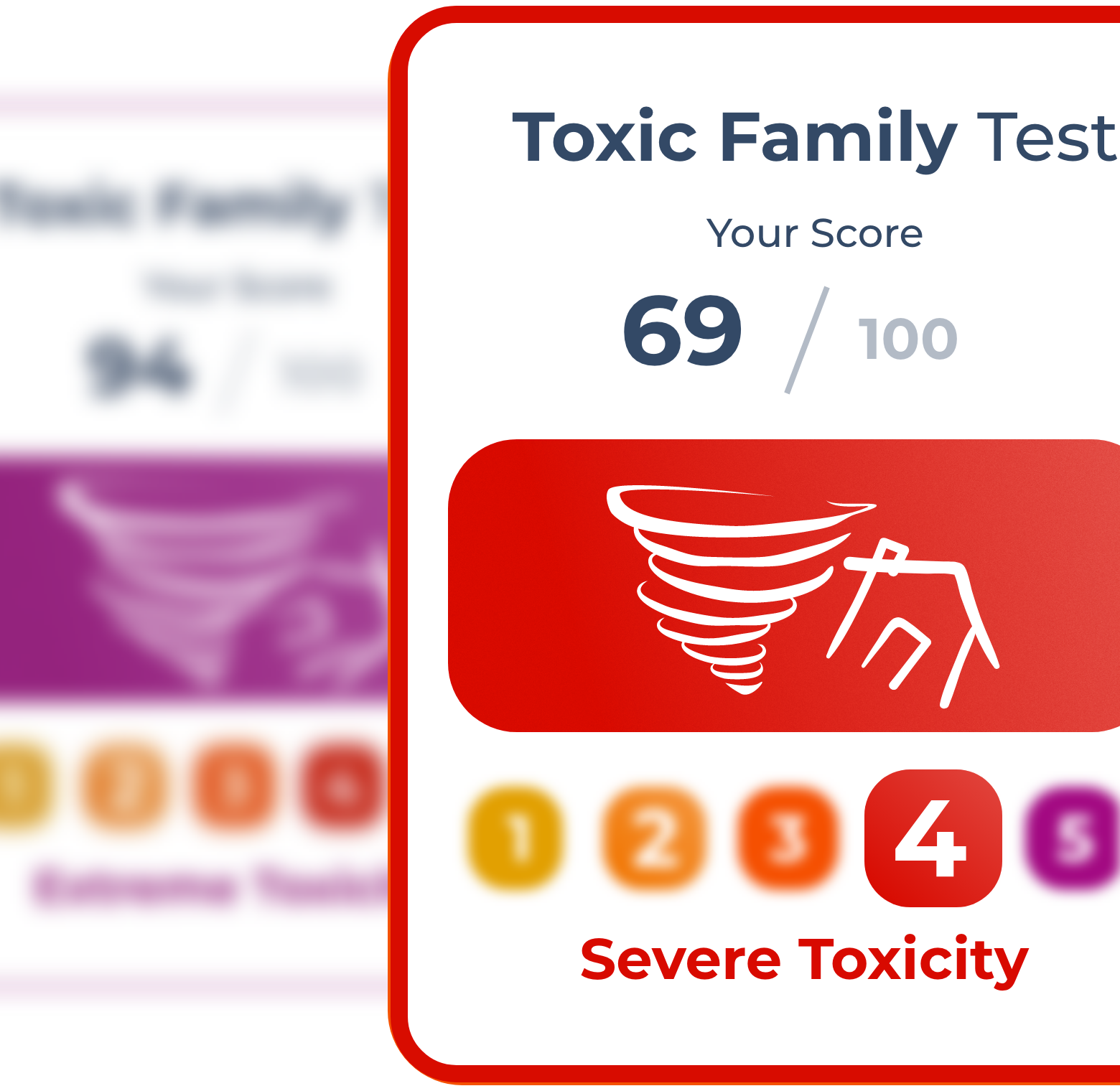
A little while later in this video, there will be a test on the toxic family system. And the test is really about this basic question. Can family toxicity be measurable? Many of you have taken the ACE study, which is the Adverse Childhood Experiences Test, which measures it's, gives a rough idea about childhood trauma.
Uh, it's not very inclusive. It measures health problems related to childhood trauma over time. Um. But it's really a rough, basic measure of things, but it doesn't really measure what's going on with the adults. It's more about the results of trauma on kids, but it's not so much about what is going on in the system that the child is growing up in.
It also doesn't really measure the dynamics of family relationships like marriages, siblings, and parent-child relationships. When caregivers are abusive, it affects the whole system. Not having a measure of that system presents two basic problems in childhood trauma recovery. There really isn't a finite empirical gauge about the toxicity in adults who are raising children and the family system as a whole, and it's usually guesswork.
That is kind of vague. Um, the second problem is the majority of clients that I've had about 90% struggle with knowing if what they grew up when was really that bad. They usually compare themselves to others and assume others had it worse. It's very common for this stuff, and you can go online and you can read posts about the, in the recovery world, about toxic family traits or toxic parent characteristics about family dysfunction or having a toxic parent, but we usually walk away still not being fully sure from those resources.
Or in some cases people can overly assign that a caregiver is highly toxic. When in actuality there may be low toxic or moderately toxic, so about that word toxic. The word toxic is being used more frequently these days. There's like the toxic girlfriend. The toxic boyfriend, there's a toxic boss, a toxic spouse, and thinking about that, I curiously looked at Google Trends.
I kind of do that from time to time, and since about 2018, there was. Been a steady increase in that word. In our online discourse. Google trends shows just trends, and it isn't used for scientific data really, but it does give us some kind of idea of the general interest over time in, in short, we're talking more about that word toxicity, toxic, but is the use of that word that is now becoming more and more popular.
Actually a bit over the top is the word toxic Overused. Or is the word toxic? Just accurate to describe a collection of behaviors and traits. So we do need to acknowledge that the word can be overused. Anything can be overused, but we also need to be able to use the word when it's accurate. So how do we become more clear about those sets of behaviors, uh, that qualify for toxic and maybe for lesser issues that just kind of make us human, or just make a human kind of harmless or albeit kind of a, you know, a pain in the ass but not a toxic person in our society.
Here's what I mean. For example, is that neighbor that you have with the leaf blower at like 7:00 AM truly toxic or are they just a pain in the ass? Or maybe they're not even that. And we have our own triggers and projections, all scenarios, and what I just said can be true. I'm not arguing for or against another.
Is your neighbor using that leaf blower because they need to get to work super early or they have forgotten that the world isn't on their schedule. Or is that neighbor just one of those beings on the planet who welcomes confrontation by using a leaf blower early in the morning because they kind of get entertainment out of other people's discomfort and upset.
We all have known somebody like that. It's kinda like what the test is about. Would they even escalate a situation with a neighbor asking them to not be so loud or using it? Would they become violent or volatile because that's their whole vibe. Would they be, would they welcome a legal battle because f those neighbors who don't get a early that I do.
So that, I'm just trying to say like that can happen too. But when we start to think about a person as toxic. How accurate are we actually? Um, are they really toxic or again, are they just a pain in the ass or a flawed human being? The same questions can be asked about our family systems, so what qualifies for a family being toxic?
You've heard me say in other videos that a characteristic of a toxic family is one that caters to the most toxic individual. That toxic individual will hold a lot of power over the whole system. All the other members kind of adjust to that toxic person in fixed roles. Usually the most damaging person can be like the narcissistic grandmother, the alcoholic father, the emotionally immature or volatile mother.
That individual or individuals can be more than one in a family. Affects the whole family in any one of the following ways in our present lives. So think about your own family in terms of this list where siblings do not fully know how to connect with themselves or with each other, that drama and crises are created.
Even when it's calm, it's like a default homeostasis that things have to be someone's fault rather than just stuff happens that there are subgroups that manifest. There's team mom and team dad, and even that can switch in a dramatic way depending on what the scenario is. Um, I know a talk a family is toxic if there is actually a scapegoat in the family.
Which I see as kind of a distraction from bigger parental problems, or there's fixed family roles like the victimy father, the golden Child, the Unprotective, codependent, other parent. Another example of toxicity is marriages can be violent and volatile or sad and really not close, like there's this sad kind of giving up and their roommates.
Another example is marriages that can be volatile. Or violent or just simply sad and not close. Like there's a, there's a roommate. Equality to him. Is that toxic? Well, we're gonna be sort of thinking about measuring that. Um, another example is marriages or partnerships that tend to only connect around misery or negativity or in power struggles instead of unhealthy ways.
Another example of family toxicity is where members will turn on each other. In relation to the most toxic in Ville, like why did you ruin Christmas? By asking mom to not scream around your kids. You know how she is. You see how that sounds, that kind of switching and the kind of the insanity of it.
Another example is siblings who struggle with healthy ways of dealing with their feelings. Another example is siblings who are, this is a big one for me, siblings who are harder on each other because there is not any accountability with the parents. Like in that prior example that I gave, um, and there's usually.
An unending battle through the generations. Now, mom is at war with a daughter-in-law instead of you for a new chapter in the dysfunction. And as you can see in these examples, the system is toxic up top with the parenting and it trickles down through the individuals and siblings and into the sibling relationships.
So now we've talked about the toxic family toxicity, but it's coming from parental influence and parental modeling. So what qualifies as toxicity in parents? Here are six categories. Moving on to that bigger question, what makes a parent toxic? You are recovering from childhood trauma and you spent a lot of time wondering perhaps your whole life, what is going on with your parents' behavior and how bad is that behavior?
Sometimes the parental toxicity or abuse is so blatant there really isn't much wondering, even when you're a kid, like you know, it's really bad in these six categories in my mind, they give us a framework for high toxicity. Think about it in terms of a scale range, low, moderate, and high. I imagine that they would have to exhibit most if not all of these.
Um, and you'll see what I mean from the test questions later. The first one is lack of accountability. I'm sure a lot of you will know what this means. This is a fixed marked refusal to see their own faults. Involvement, responsibility, or acknowledge that they've been hurtful or damaging to their kids or to their spouse, or to anybody.
It is never them. Never, ever, ever. Or you can, you can have the parent that can't handle bringing, it's not like they're super defensive or denying you. You can have a parent that can't handle you bringing anything up, and they go into this shutdown victimy place until you stop talking about it. Another of the six is poor relationships.
These can be intenses and fairs, up and down, dramatic relationships, poor romantic choices on again, off again relationships, several marriages or one long codependent, unhappy marriage, or even no relationships at all. These are involve like power struggles, boundary crossings, or again, they can avoid connection entirely and just be a totally w like lone wolf.
Number three is contempt and criticism. This is like a sadistic approach to their children's needs or to their child's vulnerability, or the vulnerability in other statements, like, why should I help you? No one helped me when I was your age. Or that's the way the cookie crumbles when you're really in pain.
When you're really in trouble, like in like in a really, really bad breakup or something. And then they might say something like, I knew that that person wouldn't put up with you. That's why they broke up with you. But I didn't wanna say anything. So that's what I mean about that contempt criticism, really off off statements.
Number four is poor insight and poor ability to improve their life or work on their problems. There is often the belief that their problems are caused by others or the, the world is doing things to them and has nothing to do with them. So all the vitriol and resentment gets in their way of getting things like better jobs or having better relationships with their children.
Number five is poor boundaries. They can easily cross personal or sacred lines into emotional, physical, and sexual abuse. They can overshare or disclose what you tell them in confidence, but they'll do that. They'll just share it with other people. Even though though you didn't ask, you asked them not to.
They can be more focused on strangers than their own family. That's a boundary problem. They can be highly entitled. They can cut lines. They can believe that they are special. They can have fast intense relationships and not be very trustworthy because they easily cross lines. And finally, at number six is duplicity.
They can rage at you and seconds later be welcoming and lovely to the male person who comes to the door and chat them up and be lovely. They can gossip out about someone at a family party and they show this. Inauthentic performative care when that person shows up, um, and that they just trash talk them and be like, oh, Gail, how's the divorce going?
We think about you so much after, just like, really character assassinating them moments ago. They can pretend to play the part of a parent, but it's only for show and attention. So moving on, the idea of toxicity is, is toxic a fixed thing? And can someone like that I just described, can they change given all that?
Another question I have around the family toxicity is, is toxicity a fixed thing In people, you may have heard statements like, there are no toxic people, just toxic behaviors. But is that universally accurate? I don't think it is. In fact, I, I find this statement wildly inaccurate and invalidating to those with toxic perpetrators in their life or in their family.
The phrase implies that everyone has capacity for deep change, which isn't universal. Some people do have that capacity, but definitely not all. And as much as we don't like to be that definitive, some people specifically. Like abusive parents not only don't change, but refuse to or even acknowledge that they can benefit from some changing.
Sometimes I'll joke with people who use that statement, if you really believe that phrase, that there are no toxic people. I'd like to invite you to move in with some of most of my childhood trauma survivor clients', parents, and see if you feel the same way in a few weeks. My point here is. High toxicity is usually fixed.
Um, is change possible? Sure, anything's possible, but how is that going? When you think of your own abusive parent, has your toxic parent had bouts of clarity or spent time in therapy or some kind of growth program and worked on behaviors that causes damages to others they know to be damaging to others or even to themselves?
Or to their life. Some have experienced, say, an extremely toxic parent, perhaps maybe get sober from substance abuse and that parent goes through a total transformation. But I don't believe that all people are capable of such psychic change. Some child to trauma survivors will experience a parent who is highly toxic from when they are born, the child.
I mean, when the child is born, they, they experience a toxic parent all the way through the lifecycle, meaning that the. The parent is toxic in their toddlerhood and they're still toxic on their own deathbed. There's no change at all in there. Moving on to this other question, why might we struggle in our recovery to call our family system toxic, which is highly common to struggle with that kind of.
Definitive statement. Coming back to the idea of measuring parental toxicity, having a reference is important, and growing up abuse, there really isn't one to determine what is healthy and what is unhealthy, because since we're children, we don't really have any help or we don't have the power to make those calls.
When growing up in toxic abuse, children usually wouldn't call their parent toxic for many reasons, such as. Their development, you know, like a 10-year-old is gonna still be hopeful that they can get the parent to be more loving if they, if the child just gets it together and stops, stop making mistakes that the parent keeps kinda getting frustrated with not recognizing that the parent is really an unsafe individual.
Kids also have no frame of reference. Our family is really the only. Family that we know. We might catch glimpses of what is healthier in things like sitcoms or at a friend's house where parents aren't screaming at each other and throwing plates. But going through it, there was, there was a part of us that kind of knew something was off, even if it was a little bit tiny.
Raise your hand out there if you remember asking yourself as a kid in the middle of all that abuse, in the middle of all that chaos. Is this really that bad? It feels bad. It's familiar or normal for my family, but is it normal? Is my parent normal? Why did they scream at that person at the bank and slam things around?
Um, it feels toxic or really bad, but who am I to say we might even, we'll definitely do that into our adulthood, um, with, with other toxic people in our lives. Other families are like this, right? This is normal. So you might actually have had friends in similar situations, and maybe it seemed like all the adults around you when you were a kid were just high intensity because that's what it's like to be an adult maybe.
I definitely remember feeling that. The second piece to not having a healthy frame of reference is, again, abuse. Children usually don't have a healthy adult in their life or safe person to validate what they're going through. There is no help or confirmation. We usually don't have a counselor or an uncle who is able to say.
You know, hey, if you're feeling bad about what is going on at home, it's totally appropriate. You're going through a lot at home, um, that aren't right or not really safe. Or if they told you what your day-to-day like isn't safe or healthy and it's not your fault, imagine how helpful that would've been just to have been seen by somebody.
I believe childhood to trauma at its root is about trauma to our perception as kids. Imagine if you got that help in grammar school to be able to. Call it like it is about your family. I think that would've changed a lot of things about us. We wouldn't struggle so much with second guessing ourselves or being poor judges of other people's character who aren't good for us.
So moving on to measuring toxicity. So given that we don't have a healthy frame of reference. We don't get help as kids or even in our adulthoods about how things are. I've seen many therapists out there who don't see the toxicity in these families at all, or they excuse it by saying, you, the client needs to rise above it or accept it or work with it.
Though I feel like those messages are pretty terrible because they kind of like. They help the client who's already kind of gaslighting themselves about how bad it is. The opposite issue related to what I just said is given that that word toxic is sometimes overused, which takes away from cases of high toxicity or declares, everything is highly toxic.
So how do we measure? How do we get a good frame of reference? Here are some questions from the family toxicity test. You can take the full test, like right up here. Um, follow the little white ball up here or in the description, in the video below. And the test is in preparation for publication. As it stands right now.
The time of this video, here are some of the test questions. And when you actually take the test up, up here, there are multiple choice answers to it. And it's not just a yes or no when I read them on the screen. Um, 'cause again, we're trying to measure the frequency. Of the occurrences is to get a sort of a better ballpark.
So question number one, my caregivers or parents seem miserable, disgusted, or aggressive towards others in my family environment. Question number two, I or other family members were ridiculed, made fun of or humiliated when they were vulnerable and in need of empathy, guidance, and support. Bouncing around to question number eight.
I witnessed or experienced instability in the relationships of caregivers. Examples shifts from idealization to hatred of each other, drama, volatility, on and off again cycles. Question number 16, I witnessed or experienced caregivers being self-involved. Exploitive and or narcissistic. Some examples being financially exploitive, treating children as commodities, living vicariously through children, taking credit or taking over children's achievements and weaponizing basic needs.
Last question, question number 18. These are just five sample questions. Eye witnessed or experienced caregivers engaging in betrayal of their children by siding with perpetrators. Examples, siding with bullying adults, siding with other abusive caregivers, or siding with a child's bullying peers. The full test is 20 questions, takes about five or 10 minutes, and you'll get the results immediately along with some treatment recommendations.
Um, you'll also see results ranging from manageable toxicity, moderate toxicity, extensive toxicity, severe toxicity, and extreme toxicity. So some final thoughts. I believe the first stage in healing childhood trauma is. Doing work on figuring out how bad it was. Um, it's usually where we all start in our childhood trauma recovery, and it's not good.
It's really not good to be flip flopping between getting abused when you're in the thick of it with your family system and then you leave and then some time passes and then you decide it's actually not that bad. Inner children have these built-in forgetters. Which contributes to us staying in abuse or not really having great boundaries.
In addition, it's not good to overshoot or overly label a system or a person as toxic when it's just kind of, you know, dysfunctional or crappy. There can still be damage there. There usually is, but not every system or individual is toxic if there is difficulty. So as always, I hope that this was helpful to you and as always, may you be filled with loving kindness.
May you be well, may you be peaceful entities and may you be joyous and I will see you next time.